Optimizing spray patterns to reduce build-up and maximize runtime
In spray drying, even small differences in spray pattern can have a major impact on production efficiency. When droplets reach areas where they should not, product build-up can quickly become a recurring issue resulting in more cleaning, shorter production runs and increased risk of contamination.
For one of our clients, this was exactly the challenge.
The challenge
The client was experiencing frequent production interruptions caused by excessive product build-up inside the spray drying tower. Product was accumulating on the inner walls and, in particular, in the upper sections and ceiling of the tower.
As contamination increased during production, cleaning had to be carried out more frequently. This reduced effective runtime and production capacity, while also increasing the risk of product quality issues and cross-contamination during longer production runs.
The challenge was therefore not simply to clean more effectively, but to understand why so much product was reaching these areas in the first place.
Our approach
Our technologist worked closely with the client to analyse the spray drying process and identify the root cause of the build-up.
The assessment showed that the existing nozzle configuration and spray pattern were not optimally matched to the geometry of the spray drying tower and the specific process conditions.
We therefore focused on the atomisation itself.
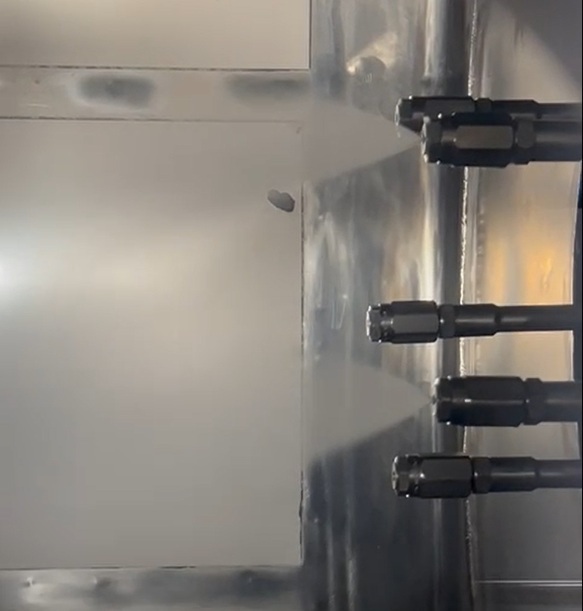
By evaluating different nozzle and swirl chamber combinations, we were able to adjust the spray angle and distribution. Several configurations were assessed to determine how the spray could be directed more effectively within the available drying space.
The objective was clear: keep the droplets where the drying process needs them and minimise the amount of material reaching the walls and upper sections of the tower.
The optimized configuration resulted in considerably less product reaching critical areas such as the ceiling and tower walls.
The result
Optimizing the spray pattern led to significantly less contamination inside the spray drying tower.
For the client, this resulted in:
- Longer production runs – more time between cleaning cycles increased effective production capacity.
- Reduced cleaning downtime – fewer cleaning interventions saved valuable production time and resources.
- Improved process stability – better control of the spray distribution reduced unwanted deposition inside the tower.
- More consistent product quality – limiting contamination contributed to a more controlled production environment.
This case demonstrates that product build-up is not always simply a cleaning issue. In many cases, the origin of the problem can be found much earlier in the process in the way the liquid is atomized and distributed inside the spray dryer.
Is build-up limiting your spray drying process?
At Raca International, we look beyond the nozzle itself. By analysing spray patterns, nozzle configurations and process conditions, we help our customers identify the causes behind spray drying challenges and find solutions that fit their specific process.
Experiencing excessive build-up, frequent cleaning cycles or limited runtime? Contact us to discuss your spray drying process.
- Raca International
- +31 (0)252 - 25 55 61
- Arnoudstraat 22 | 2182 DZ
- Hillegom, The Netherlands
- info@raca.nl